Category: Uncategorized

Climbing Out of Higher Education

Hello blog world, it’s Allie.

There’s a huge contrast between my life right now and what my life will be in two weeks. In two weeks, I’m leaving college and Flagstaff to join Nick in California. A lot of people feel adrift after college, especially people with English degrees. I think, as a relatively intelligent person, I probably should have chosen a STEM major, but when I arrived at college, I had vague ambitions about being a lawyer. I also felt a powerful pull towards writing. Now, after four years in school, my writing has improved technically, but my creativity has gone to shit. I think in prescriptive, dull ways. I’m wondering if I can make myself intelligent again. School has taught me to be risk averse, to cram my ideas into a conservative little box with a topic and closing sentence. Climbing has been my saving grace. On rock, I have to improvise. I have to be creative. Coupled with skiing, climbing has kept me from going insane. Without a handful of hours in the gym each week, I couldn’t have forced myself through my monotonous college routine. The promise of a climbing trip always gleamed on the horizon.

Fortunately, I didn’t go into debt. I was lucky. I could have paid a much steeper price for becoming less capable. It’s a little like Kurt Vonnegut’s Harrison Bergeron. In Harrison’s society, people who are too attractive or too smart or too talented in any way are handicapped. That way, everyone comes out average. College accomplishes roughly the same thing. In the end, we’re all good workers without any exceptional talents.

In college, I have been told what to think, not taught how to think. In the humanities, you’re supposed to learn to think critically. You’re supposed to be able to look at the world and select your own values. In reality, in a humanities program, you’re fed watered down liberal values. You become a faux-environmentalist semi-queer-and-feminist anti-racist person who occasionally posts provocative articles on Facebook. Then, your half-ass political friends congratulate you for being socially aware, for liking the right people—Obama, Beyoncé, Ta-Nehisi Coates, etc.—and disliking the right people—Trump and his scourge of the earth cabinet. Somehow, we’ve packaged radical ideas—the James Baldwin-Angela Davis-bell hooks cannon—into something easier to swallow, something innocuous. We’ve made ourselves useless.

Humanities professors, with their liberal ideologies and quirky clothing choices, have the best of intentions, but they’re academics. They tend to be wildly disconnected from the world. Most professors, excluding a few, are entrenched in their academic fetishes—the oddly specific topics they’ve written a dissertation, a book, two books, an article, a hundred articles about.

That’s not to say I haven’t been exposed to some truly incredible writers, from Junot Díaz to Jennifer Egan to Anne Carson. For a bookworm like me, even college can’t fuck up books. Even college can’t fuck up great raw material. I’m hoping I can apply the same logic to myself. Even college can’t fuck up my mind, my ability to think freely. Still, I’m not sure. I spend too much time online. In many ways, school has taught me to favor virtual experiences over real experiences. I have been rewarded for spending time online, plowing through articles and research, with grades. In writing Projecting Reality, in dedicating my life to climbing, I’m working to reclaim my mind. Curiosity and passion separate people who are truly alive from people who are simply going through the motions. I want to feel alive again, and climbing has a way of making you feel almost too alive. Climbing shocks you into feeling—into engaging with the world in a raw, unscripted way.
Nick’s July Update

Hi, it’s Nick here. Last week, Allie came out to visit me in San Carlos. She’s planning on moving out to the San Francisco Bay Area in August. It’s an exciting but stressful time for us. Fortunately, Allie managed to secure a couple of job offers, and potentially, even a place to live. Things aren’t set in stone yet, but we’re more or less sure Allie will be able to move out here, which means we can slowly shift our focus towards Yosemite. Allie and I are strategizing about how many trips we will take and about which climbs we will tackle. We may end up loosely basing our schedule around Chris McNamara’s book, Road to the Nose.

Now, we have dates and a destination—Yosemite and the Tuolumne area—for our first trip. After Allie drives out to the Bay Area in August, we will squeeze in a trip before she starts working. Our first trip will be more of a training trip than a performance-oriented trip. We will work on our skills and our systems, but mostly, we will get used to working with each other on the rock again. In climbing, as in every team sport, it’s important to practice together to develop better teamwork. We might try some of the shorter routes near the base of El Capitan or other short aid climbs in the valley. For non-climbers, aiding involves clipping aiders, ladders made of nylon, to pieces of gear to gradually move upward. In aid climbing, you directly rely on your gear to make upward progress, as if you’re creating your own staircase. In free climbing, another climbing discipline, you only use gear to catch you in the event of a fall. It’s been a year since I last led an aid pitch. At first, I will need to climb at a little slower pace to get my “aid head” back.

After our first trip in August, we plan on attempting Washington Column again. Last summer, on our first attempt, we made every possible mistake. We brought too much stuff and started too late. Then, we couldn’t even find the start of the route. Once we started climbing, our hauling situation was inefficient at best and downhill at worst.  In total, we spent two nights getting half way up a one-night climb. It was humbling to get our asses handed to us by a piece of rock, but our experience on Washington Column opened up the world of big wall climbing. Big wall climbing involves spending multiple days in the vertical with nights spent sleeping on a ledge or portaledge. Portaledges are platforms climbers carry with them and construct on the wall. In spite of all of our mistakes, Allie and I managed to sleep on Dinner Ledge, a plush ledge on Washington Column. We were in awe. Across the valley, we could see other climber’s headlamps. Below us, we could hear the bustle of tourists removed from us by only a couple thousand feet as the crow flies, or more accurately, as the stone drops. Much more importantly, we were separated by years of practice, imagination, and the guts to try. Big wall climbing means looking up at an impossibly big face and deciding to make it possible. Everyone needs something like big wall climbing in their lives, something they love, something they’re willing to risk everything for.  In the fall, Allie and I will try Washington Column again, and with the right combination of hard work, skill, and good weather, we will succeed.

Nick’s Introduction

I’m Nick, and I’m coauthoring Projecting Reality with Allie, my girlfriend and climbing partner. We first met about four years ago while we were both attending Northern Arizona University in Flagstaff. We divided our time between skiing too much, climbing too much, and drinking too much Jameson. Allie spent a lot of time buried in books, and I spent a lot of time digging her out, pulling her into the outdoor world.

During the winter, I worked long hours as a Ski Patroller at the local hill, and during the summer, I lived an equally blissful lifestyle. After working late nights as a bouncer at a local bar, I slept in most mornings, messed around on my guitar, and acquired an array of houseplants. Most afternoons, I spent sport climbing with friends at The Pit or bouldering at Priest Draw.

On the morning I met Allie, I was sitting on my couch with my front door open. I had passively observed some people moving someone into the apartment next to me. I didn’t think much of it until I saw a girl carrying in a crashpad, the kind used for outdoor bouldering in Flagstaff. Six hours later, Allie was sitting on my couch, telling me about how she spent the last three months in Patagonia on a sea kayaking and mountaineering adventure. A week later, we hiked up Mt. Humphreys in the San Francisco Peaks. We slept on the ridge between Agassiz and Humphreys. As batsflew overhead, we watched a gorgeous sunset and made an excellent meal. Looking back, our night on Humphreys was the birth of our outdoor partnership.

In time, Allie became my primary climbing partner. We went to the gym together, trained together, and worked on our living room hangboard together. Allie took up skiing and eventually became a ski instructor. I left Patrol and worked nights downtown to make more time to climb. Our climbing relationship grew, moving from relaxed afternoon bouldering sessions into sport climbing. We then jumped into the world of multi-pitch traditional climbing. In traditional climbing, you place small pieces of metal called nuts and cams in cracks, and you then clip rope to the gear to protect yourself in the event of a fall. Essentially, you take something seemingly impossible, and gradually, you work up to accomplishing your task. We started at our local crags and worked up to larger climbing destinations.

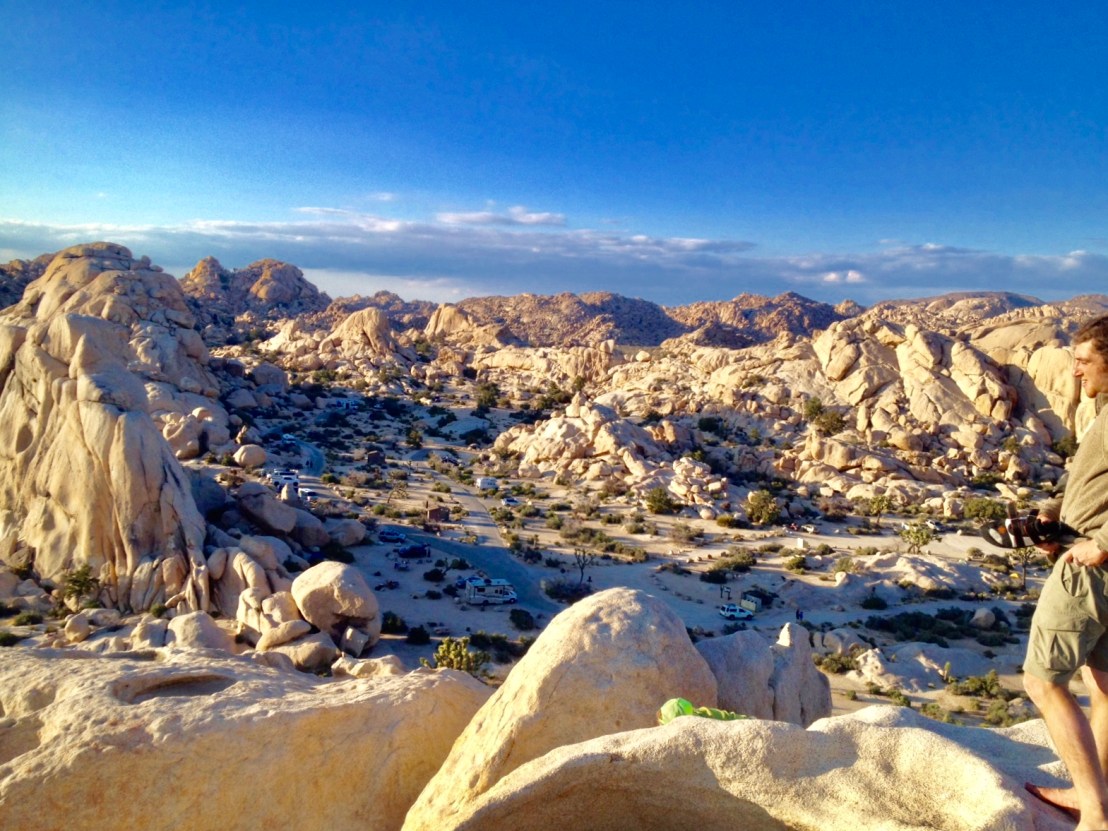
Our first road trip to Joshua Tree—equal parts climbing venue and desert paradise—was a turning point in our climbing relationship. In Joshua Tree, grippy rock, solid gear placements, short approaches, horrifying slabs, and skin chewing phenocrysts combine to create vertical ecstasy. One night, after a $3 dinner of gas station hot dogs and a couple sunbaked cans of beer, I went for a walk around Hidden Valley campground. Before I knew it, I was scrambling then bouldering. As I climbed through the moonlit, alien landscape, I felt the hot nighttime wind run overmy body. I felt incredibly free. Eventually, I found myself sitting on top of a rock formation called the Blob, looking out at the Joshua Tree studded landscape. Something clicked in my head up there: the world, the land, people, life itself—it didn’t have to all be dominated by fear and anxiety, by arbitrary limits and norms. Life could all be a playground. We could have exceptional experiences. We could climb—and climb hard—and not simply read through Rock and Ice and climbing guides, always dreaming and rarely doing.

fullsizeoutput_1f
Hidden Valley Campground in Joshua Tree National Park

Since our first trip to Joshua Tree, we have both grown a lot. We have ventured into alpine climbing in the High Sierra, and at the end of last summer, we took an unsuccessful but exciting shot at Washington Column in Yosemite. Our experiences have given us a solid jumping off point. Now, it’s not only about climbing. It’s about engaging with the world—with life, danger, and fear in a real way, not in a sterilized way. In climbing, your ability protects you, not someone else’s guarantee. If you fall, there’s no one to sue. It’s all in your hands. Allie and I want to take on real risk, adventure, and reward.

For us, the next step involves leaving Flagstaff. There are many reasons, but more or less, we need a larger playground. In November, I moved back to the San Francisco Bay Area, where I grew up, and I began working at a local bike shop. Cycling has become a fun compliment to climbing. Allie will move to the Bay Are in August, and we hope to climb in Yosemite for a few seasons. Multi-day big wall climbs will demand a new level of commitment and skill. In addition to Yosemite, we hope to travel to the Tetons, the Bugaboos, the Cascades, and hopefully, Patagonia over the next decade.

As we adventure, we hope our friends and family will read our blog and keep tabs on our adventures. For us, climbing has become a form of meditation, a way to expand our limits. We hope, if other people stumble across our blog, they will feel inspired to live life on their own terms, to seek out their own adventures.

Projecting Reality: The Premise

Hi, my name’s Allie, and along with my climbing partner and boyfriend, Nick, I’m here to introduce you to Projecting Reality. Nick and I are both rock climbers and outdoor enthusiasts. We met in Flagstaff, Arizona several years ago, but we are in the middle of a move to San Carlos, an area outside of San Francisco where tech companies—Google, Oracle, Facebook—reign supreme. In contrast to many people our age, who would be content to never leave their gentrified neighborhoods or their company’s campuses, we hope to use the Bay Area as a gateway to Yosemite. In Yosemite, we will pursue big wall climbing—multi-day rock climbing—as a team.

Even if you aren’t a climber, there’s something beautiful about seeing someone push past their physical and emotional limits to ascend a piece of rock. Climbers call the process of working through limits projecting. As you piece together a series of move on your project, you gain a new understanding of climbing and your personal hang-ups. Often, the changes you need to make are subtle—a slightly different way of grabbing a hold, a little more boldness or dynamic movement in your approach. Over the years, Nick and I have started to apply the projecting mindset to our lives. We have learned to carve out time to climb, train, and adventure.

As our generation tends to value virtual experiences over real experiences, we hope to use our blog to talk about experiences of real danger and real adventure. We want to document both our successes and our failures, and maybe, we can produce a blueprint for other millennial adventurers. It’s easy to become entrenched in social media, video games, and status symbols, but we don’t all value representations of reality over reality. Nick and I want adventure you have to pay for with hours in the gym and genuine commitment. In other words, we are projecting our reality.